Surrogate models
A useful approximation
When each simulation takes substantial time, exploring every possible input can be impractical. A surrogate model approximates the relationship between inputs and outputs using a selected set of evaluated cases.
General educational reading · Not a description of company activities.
Learn from selected cases
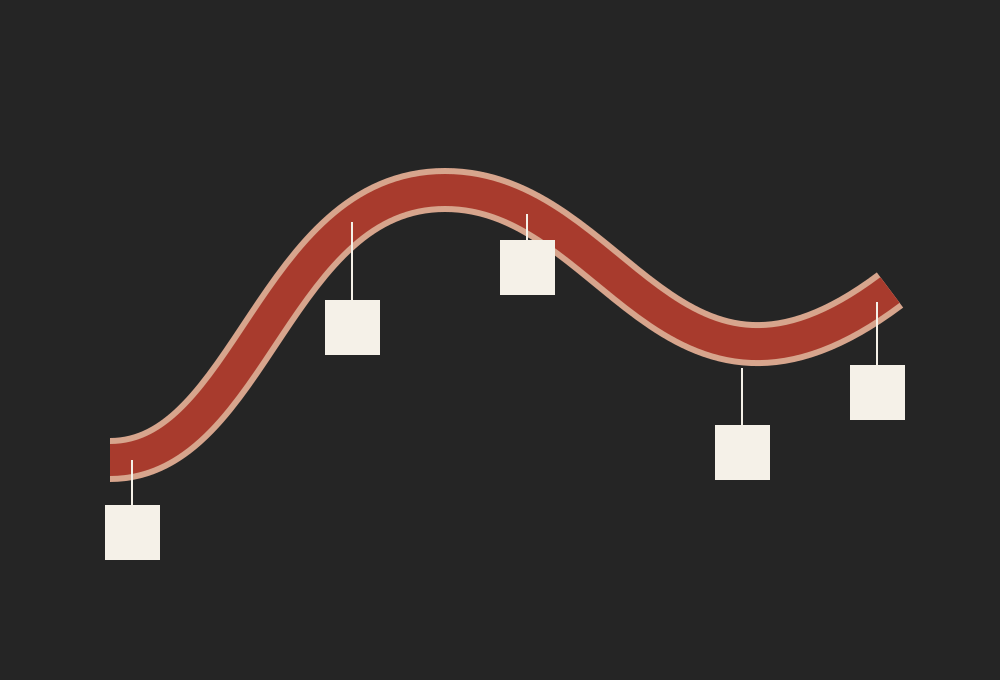
The original calculation provides reference points. A simpler mathematical representation is fitted to those points and used to estimate other outcomes. The approximation can help identify promising regions for further evaluation. Its usefulness depends on the examples it has seen and the behavior it is asked to represent.
A hypothetical design choice
Imagine comparing possible shapes for a small enclosure. Detailed calculations might be reserved for selected shapes, while a surrogate helps screen nearby variations. A promising prediction would then be checked with the detailed calculation. This is an illustrative workflow, not a report of company activity.
Keep the limits visible
An approximation may behave poorly far from its reference cases, near abrupt changes or in sparsely sampled regions. Checking on cases withheld from fitting can reveal some weaknesses. Record the input range and the quantity being approximated. A faster estimate is useful when its limits travel with it. In the enclosure example, changing the material would introduce a new question about applicability. A reader should be able to distinguish a variation within the explored cases from a change that needs fresh reference calculations.
Further readingMathWorks: surrogate optimization