Mesh refinement
How much detail is enough?
Many numerical simulations divide a continuous shape into smaller elements. The resulting mesh helps turn a physical description into a problem a computer can solve.
General educational reading · Not a description of company activities.
Choose what to watch
A mesh study compares a selected output as the subdivision changes. That output could be an average temperature or a displacement at a particular location. Stating the quantity first gives the comparison a purpose. Counting elements alone says little about whether the answer is useful.
Refine with a question
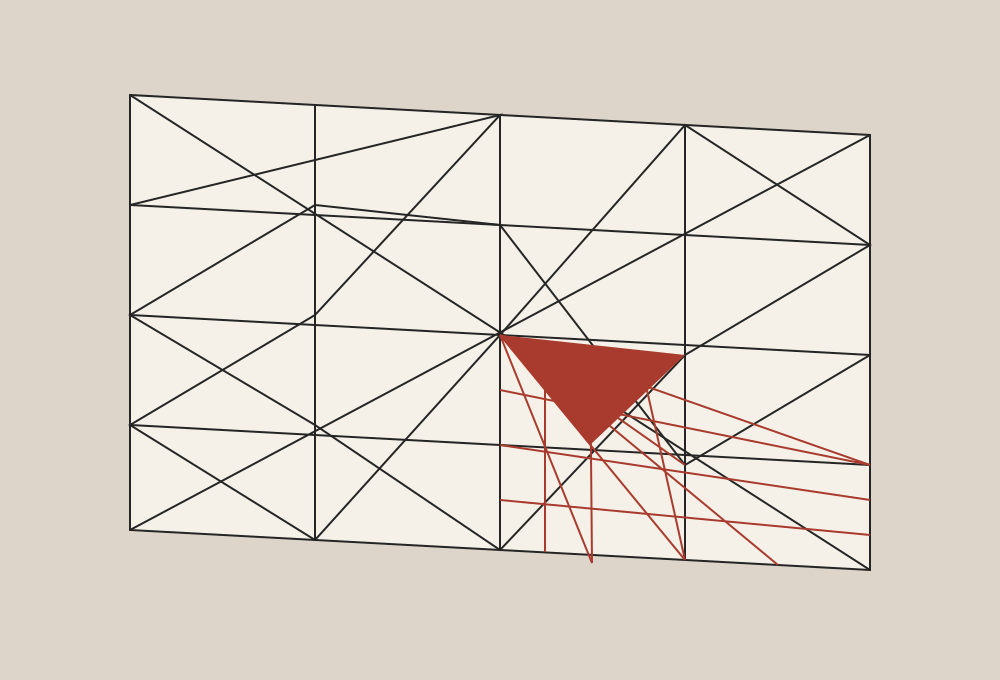
Consider a hypothetical plate with a small opening. An analyst might use smaller elements near that opening and larger ones farther away. This concentrates computation where the geometry or solution needs attention. Local detail still needs compatible transitions and appropriate element quality.
Know what stability means
If successive refinements barely change the chosen output, the result may be approaching mesh independence for that quantity. Other outputs can behave differently. Refinement also cannot repair an unsuitable physical model or incorrect boundary conditions. A stable answer is therefore one piece of evidence, alongside assumptions, comparisons and the intended use. For a reader, a short explanation of why a particular output matters can be more informative than an elaborate mesh image. It connects numerical detail to the question that the calculation was intended to answer.
Further readingAnsys: adaptive convergence and refinement